
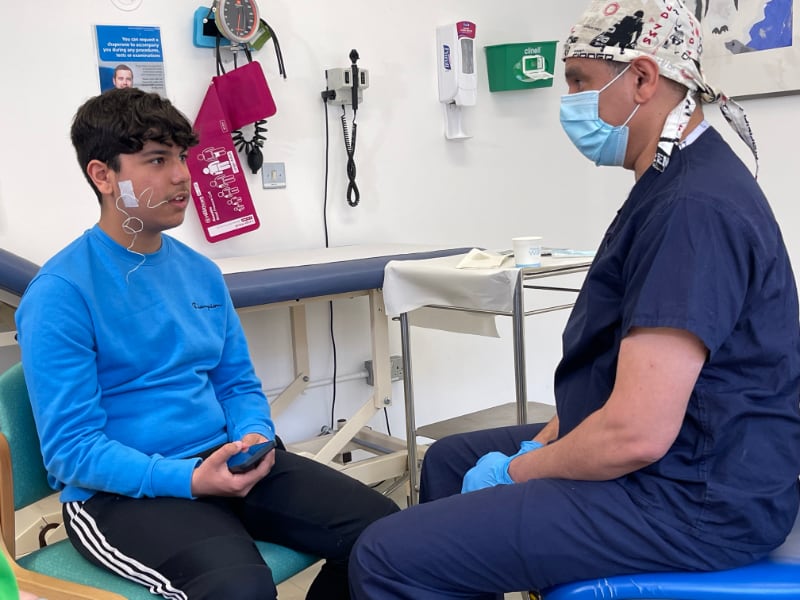
Dr Nadeem Afzal conducts string test on young patient
Doctors at University Hospital Southampton (UHS) are using a pioneering ‘string test’ to help monitor and manage a condition which can cause difficulty in swallowing and eating.
Known as the Coiled oEsophageal String Test (CEST), it involves swallowing a thin piece of specially designed coiled string which is secured to the cheek with tape and unravels when it is washed down with water and enters the stomach.
After 30 minutes the string is removed by gently pulling it out of the mouth and then sent for analysis.
It has been designed to monitor and treat Eosinophilic Oesophagitis (EOE), an emerging chronic inflammatory condition of the oesophagus (the tube connecting the mouth to the stomach) which affects one in 1,000 people.
Symptoms can include reflux, sickness and discomfort while swallowing with food occasionally becoming stuck, known as food bolus obstruction.
Food is a recognised trigger for EOE, with milk and wheat the most common, so changes to patients’ diets are required to exclude possible causes.
Therefore, the only way to determine the impact of dietary changes until now has been through regular endoscopies with biopsies proving invasive for patients as well as costly.
The new non-invasive string procedure, developed by Dr Efrem Eren, a consultant immunologist at UHS, gives a quicker and more cost-effective alternative.
It is a simple way of monitoring patients with EOE and its unique design is safe, comfortable and easy to swallow – even for children as young as six and those who cannot swallow tablets.
Dr Eren said:
Before this test patients would sometimes have to endure numerous invasive endoscopy procedures a year which, especially for children, can be quite traumatic and disruptive.
The simplicity and ease of this test means they are in and out of hospital within an hour without needing an anaesthetic.
Dr Nadeem Afzal, consultant paediatric gastroenterologist at UHS, said: “Biomarker measurement is a new proven revolutionary method to assess inflammation and reduce the need for repeat endoscopies in chronic conditions like Crohn’s Disease and Colitis.
Now, for the first time in the UK, we can now offer a string test to children with EOE – another chronic condition – which is a simple to perform during a short 30-minute clinic visit, reducing the stress and anxiety for children and their families and the need for repeat endoscopies.
One young patient from Southampton aged 13, was diagnosed with food allergies (egg and dairy) when six months old. Last year he developed difficulties in swallowing, had to cut his food up into small pieces and suffered from severe reflux when eating.
After seeking advice from the allergy clinic at UHS he was referred on to gastroenterology where he was diagnosed with EOE.
He said:
The endoscopy hurts for days after and I have to have time off school, but this is really easy and you hardly feel a thing – I much prefer having it done this way.”
The patient’s mum said:
We are so grateful to be able to have the string test, it is literally life changing for us. It’s such a simple and effective procedure that Eli can have during a school day and return to school straight after.
The alternative is an invasive and painful procedure, where he would have to miss at least two days off school each time.
We are very lucky to have this at Southampton.
At present University Hospital Southampton is the only NHS trust in the UK using this test as part of routine practice in adults and children, with more hospitals hoping to adopt the method in the future.
